All posts by Sailing Director

Race Night Report, June 15, 2017

Sit back and hear the tale of the amazing submersible Albacore.

Race night got off to a great start!  We had a good number of people show up, although most elected to take double handers which reduced the number of boats on the start line.  The wind showed up as well, with steady winds of about 12 knots and gusts in the 16-18 knot range, from the East.  A fairly short course set by Sydney and Reese let us get three races in.

Race 1 was all about figuring out the course.  A shift in the persistent wind meant that most people figured out that port tack would be favoured for most of the leg.  Tony and Jason (Tasar) decided to roll the dice and try a port tack start near the pin end.  With only about 5 seconds before the start, Norm and Carla (Albacore) were coming up to Tony/Jason on starboard, and it looked like Tony/Jason would have to cross early or tack (screwing their start), but Norm/Carla elected to tack onto port right as the gun went (giving Jason/Tony a repreve).  Chunshu and Tom (Albacore) decided to not repeat Tom’s OCS start last week, and gave the start line plenty of room.  The positions held through the race, with Jason/Tony winning, followed by Carla/Norm.  Tom/Chunshu ended up taking on some water and decided to abandon the race to bail their boat.

Race 2 found us joined by Ray (Laser).  By this time most of the sailors had figured out that the port tack start was the winner, but it seemed that Tony/Jason had the favoured pin end all to themselves.  They were able to make the windward mark first, but a battle between Ray and Carla/Norm meant it was neck-and-neck through for second.  Bad judgement on Jason’s part during a shift meant that both 2nd and 3rd place boats gained on Tony/Jason during the downwind leg, with Carla/Norm just a few feet away from establishing overlap around the mark.  Tony/Jason held on for 1st, while Carla/Norm took 2nd and Ray 3rd.

The final race, the game was on!  Norm/Carla won the start with Ray and Chunshu/Tom close behind.  Tony/Jason mistimed their start and had some catching up to do.  But what’s this?  Why is Carla/Norm on starboard tack?  A mistook mark and, the Carla/Norm Albacore was off the course, and had a lot of catching up to do.  Meanwhile, Tom/Chunshu had some trouble at the upwind mark!  Oh no, it looks like their tipping!  Capsize!  Jason/Tony went on to win the race, followed by Ray and Carla/Norm.

The amazing Albacore U-Boat

The real fun was at the upwind mark where Chunshu/Tom were still having trouble.  When the boat was righted, it was sitting rediculously low in the water and would capsize again immediately.  Three capsizes later, we find that their tiller has broken completely off from their rudder head.  They were towed to safety by our intrepid RC (thanks, Reese & Sydney!) with a special shout out to Tony who jumped in the power boat to lend a hand if needed as well.  When the boat got back to the shore, we found that not only was the rudder head busted, not only was the boat full of water, but 3 of the 4 bouyancy tanks were filled as well.  No wonder it was so hard to right!

Race 1 Results: 1st Tony/Jason (Tasar), 2nd Norm/Carla (Albacore), DNF Chunshu/Tom (Albacore), DNS Ray (Laser)

Race 2 Results: 1st Tony/Jason (Tasar), 2nd Norm/Carla (Albacore), 3rd Ray (Laser), DNS Chunshu/Tom (Albacore)

Race 3 Results: 1st Tony/Jason (Tasar), 2nd Ray (Laser), 3rd Norm/Carla (Albacore), DNF Chunshu/Tom (Albacore)

A thank you also goes to Jean and Frank who tended the BBQ and great beer/burgers were had by all.


Race Night Report, June 8, 2017

Boats are at the water, and race season is off to a start!

We had two races in light but very shifty conditions (the wind flipped 180 degrees, and we raced a Windward/Leeward course since the gybe mark was on the wrong side of the course).

Tom N and Norm took out an Albacore, and an OCS start cost them in the first race.  Ray in a Laser and Jason in an Albacore battled it out to the windward mark when Ray’s mainsheet let go of the boom block and became unthreaded.  Jason took a couple of penalties on the second upwind, but managed to hold on for first.

1 – Jason
2 – Norm, Tom N
DNF – Ray

With Ray’s boat jury-rigged, Race 2 was held.  The wind however unfortunately died further and Jason was just able to finish before we were in drifting conditions.  Rather than go into shore like any sane person (Ray), Norm and Tom elected to spend an extra half hour on the water to complete the final leg and claim 2nd (rather than DNF)

1 – Jason
2 – Norm, Tom N
DNF – Ray

Post race beer/burgers were enjoyed by all (many thanks to Frank and Jean for cooking!) as we discussed the best way around the modified course using paper plates and beer bottles


Photo credit to Frank Boyaner

Advanced Sailing Skills – June 3, 2017

On the water lesson (log entry below).  A couple theory items first…

Surfing

The instructors took advantage of the medium-high winds to talk about surfing.  The idea was to learn to catch a wave while running and have the wave increase your speed.  The instructors recommend watching your transom, and (when a wave is about to hit) giving the sail a “pump” to try to catch the wave, and ride it.

Death Rolls

The Laser boom can be let out all the way to 90 degrees (and even past!).  This is a blessing, and a curse.  A blessing, in that it give you lots of options.  A curse in that one of those options is to put the boat into “death roll” mode.

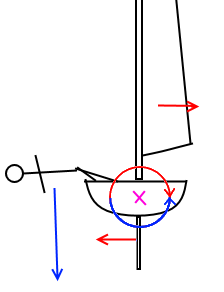
Imagine you’re going along downwind.  You have your boom out 90 degrees to the centreline of the boat (on port tack) and your sail controls are loose (to generate as much power as you can).  The bottom of the sail (blue, in the diagram below) is happily generating tons of forward power.  The top of the sail however twists off in front of the mast (red).  It’s generating power too.

Where we normally expect the boat to be heeling to leeward (starboard, in this example) so we’re probably sitting on the windward side of the boat (port).  But the top of the sail is actually pushing the boat to windward (port) which will cause the boat to heel to port.  Our natural reaction, when the boat starts to heel will be to move closer to the centreline, to do it “too much” and the boat will get into an osculating back-and-forth rolling pattern (will can capsize you pretty quick).

So, how do you recover if you feel your boat starting to roll?  You have a few options, all of which are valid and easy (as long as you recognize what is happening and respond quickly):

  • Sheet in — get the top of the sail pointing forward, and the bottom pointing a little bit to leeward.  This stabilizes you real quick and allows you to balance the boat
  • Head up into the wind slightly — this will cause the top of the sail to luff and stop generating as much power, meaning you can organize the bottom of the sail before heading back downwind.

One you have avoided the death roll, there are a few things you can do to discourage it from happening again:

  • Sail with the sheet in slightly (maybe the boom is out 80 degrees instead of 90)
  • Put a bit of boom vang on — this costs a bit of power, but prevents the top of the sail from twisting so much, and you can recover some forward power from that area

You can see in this youtube video a sailor who is blasting along downwind with his sail at 70-80 degrees for most of the video.  At about 28s into the video he lets it out to 90, and you can see how quick the death roll happens if you’re not ready to sheet in (or head up)

Log Entry

Weather Forecast: cloudy, steady 10 knots from W
Observed: partly cloudy, wind 8 knots from NW, with occasional gust in 12-15 knot range (from either N or W)
On the water: waves died out meaning it was tough to find a trough to surf the boat in.  Windward beats were good, although my roll tacks were particularly sloppy today.  To work on next time — stay on old side of boat longer through tack, and do a smoother sit down on new side.  Give larger pump when wave approaches to initiate surf.


Advanced Sailing Skills – May 29, 2017 – Rig Tuning

Tom was again our guest speaker, talking about the slot effect and rig tuning.  A couple of videos were shown which demonstrated what he was speaking about.

The Slot & Jib

The space between the jib and the main is called the slot.  In a perfect world, the air travelling on windward side of the jib (the “inside” of the sail) is then directed across the back (leeward) side of the main at higher pressure.  The main and jib thus work together to create a jet of air through the slot and generate great sail force.

The tough part is setting up the jib (and main) to maximize the slot effect.  You do want the slot to narrow (scoop up a bunch of air before blasting it out) but if it becomes too narrow then the slot gets “choked off” and can’t generate the power.

There are three edges to the jib: the luff, the leech, and the foot.

The Luff – We can tension the luff by pulling hard on the jib halyard.  A tight, straight, luff will allow us to point nicely.  In heavy air, the wind will try to bow the luff out sideways, making it curved, and you might need more tension.  Some people (better sailors than I) loosen the halyard slightly on downwind legs to try to get some curve in the luff and gain power.  If you try this, remember to tighten it up again before turning upwind.  The Albacores have (or had) “magic boxes” which are sets of lines and pullys that you can use to set luff tension via the halyard.  Some newer racing Albacores have a normal halyard, but also have a “jib cunningham” which allows you to tighten the luff by pulling down at the tack (and this is usually adjustable from the side of the boat, rather than at the mast).

The foot and leech – Tension on the foot and the leech of the sail are provided by the jib sheet.  The position of the jib fairlead controls the angle the jib sheet is pulling, and therefore controls the ratio of how much tension is applied to each edge.  If the fairlead is far forward, the sheet pulls “down” and most of the tension will be on the leech.  If the fairlead is back, the sheet pulls more horizontally, and the tension is on the foot.  A recommendation from Michael McNamara (British sailmaker, who hosted a Youtube video on rig tuning) suggested that if the line from the jib sheet went to just below the middle of the jib, then things were about right.

Note that as the jib is sheeted in and out , the “perfect angle” noted in blue may change.  Recall what we are trying to do — compress the air flowing through the slot, but leave the slot open enough that it doesn’t get choked off.  This implies that the perfect jib tension, and sheet angle, will change depending on wind conditions and point of sail.  Experiment, figure out what works, and what does not.  When something doesn’t work, use your knowledge of what you are trying to accomplish to figure out why it doesn’t work.

Rule of thumb – you often hear people say “move the fairlead forward upwind, and back downwind”.  While that might be a starting point, use your knowledge to tune your setup.  For instance, in light wind, it is easier to cause turbulence because the luff is too tight and the air doesn’t have the momentum to maintain laminar flow.  So you’d want the fairlead slightly farther back than the “full forward” position.  Similarly, in heavy wind, there’s more air flowing, so you need a bigger slot (again, move the fairlead slightly back).  In medium air, all the way forward may (or may not) be justified.  Figure out what works for your boat, for your sail, for that day, etc.

The Main

Tuning the mainsail is vastly different on a boat with shrouds/spreaders (Albacore, Tasar) compared to a boat with an unstayed mainsail (Laser, Invitation, Byte).  I’ll highlight differences in red.

Both types of boats tend to have bendy masts (and stiff booms).  By controlling the tension on the different edges of the mainsail (and on the jib halyard) we can control how much the mast bends, and that lets us control the shape of our mainsail.  On boats with shrouds, we can also control where the mast bends, somewhat, meaning finer grain control on the shape of the main.

There’s a lot of information here to unpack, and no easy “order” to present it all, since each part kinda relies on knowledge of what other parts are doing.

Inducing mast bend via mainsheet and vang

Pulling on the mainsheet pulls the boom “in” towards the centreline of the boat, but also pulls the boom down.  This tensions the luff of the main.  The vang (or “kicker” as UK/Aussies/Kiwis might call it) pulls down on the boom without pulling the boom in, but also pulls the boom forward into the mast.

On an unstayed boat (Laser and friends), cranking on the mainsheet or vang tightens the leech, and bends the mast along its length, flatting the main and reducing twist.  The top of the mast tends to be a bit narrowing (and bendier) to encourage the mast to bend more at the top than the bottom.

On a stayed boat (Albacore and friends), tightening the vang causes the boom to push into the mast, bending it in the lower section and tightening the leech in the lower part of the sail.  This also relieves  the tension at the top of the sail, allowing the top of the sail to twist off,

Laser: vang or mainsheet to tight leech along whole sail and reduce twist

Albacore: vang to tighten leach at bottom, mainsheet to tighten leech at top.

Double-handers require you to manage sail tightness in two locations — above the forestay, the mainsail is acting like a jib (or like a Laser sail) and needs to be adjusted to the wind.  Below the forestay, the main’s job is different as it’s working the air through the slot instead of directly in the wind.  Use the vang and mainsheet tension to manage these two areas.  It’ll take some practice and getting used to (and I’m not confident enough in my ability to write about it).

YouTube for the win

RYA Rig tuning clinic: https://www.youtube.com/watch?v=mVFnnHGUIOs


Race Night Report – Thursday June 1, 2017

The high water (and fact that boats weren’t yet at the beech) meant that the June 1 race night was a practice race, and will not officially count towards the season score.  We did get a few boats on the water though to run through the course and work out some kinks in our race plan.

Weather

This was really the story of the night.  A forecast 10 knots (with gusts of 15) did not come to pass.  Instead, we got about 6 knots with gusts in the 12-20 range.  A couple of capsizes happened throughout the night, but those who managed to hold on were flying in the gusts.

The Results

Chunshu and Norm (Albacore), Ray (Laser), Carla (Byte) and Jason (Laser) braved the couple of races, but end results were not tallied.  Notably, Jason sailed the wrong course in the first race, and others apparently chose to follow (pro tip — never assume Jason knows what the heck he’s doing)

The Apres-sail, the RC, and other comments

Many thanks to Frank and Jean for bringing hamburgers and refreshments, and instructors Sydney and Reese for doing Race Committee duties.  They set a course and ran a couple of quick races, all while keeping an eye on the fleet from a safety perspective.  As a final note, the Ottawa Skiff and Cat Grand Prix (OSCGP) is running this weekend, and Nepean One Design (NOD) is running the weekend of June 14.  KSC members are more than welcome to take a KSC cat to OSCGP and to take an Albacore or Laser to NOD.  See nsc.ca for details on these regattas.

Advanced Sailing Skills – May 27, 2017

Little in the way of new theory discussed.  Carla did show a nifty trick for stepping a Laser mast if you’re light:

  1. Make sure there’s a tire under front of boat
  2. Stand mast beside boat (point head of mast into the wind to have wind help lift it)
  3. Stand on deck of boat
  4. Can now lift mast vertically onto deck of boat and into mast step

Alternatively, just sail a Byte and you don’t have to worry about the mast.

Since there’s not much else to write about, I’ll mention log books.  If you don’t keep a log book, I recommend doing so.  Sometimes it’s fun to look back at past sails.  Sometimes you’ll remind yourself of a long-forgotten tip.  My typical log book entry looks something like this:

May 27, 2017 – KSC Advanced Skills
Forecast: 6 knots from the W, sunny, high of 24
Observed: About 4 knots with occasional gust of up to 6, coming from S.
Boat: Tasar (blue)
Plan: Sail into the gusts, if available.  Work on using heel to facilitate steering both tacks and gybes.  Since this is first time sailing with Frank in a couple of years, focus on communication between skipper & crew.  Tasar likes to be sailed flat (even more so than Laser) so work extra hard on keeping boat level when we’re not trying to turn.
Postmortem: Communication with Frank was excellent in both directions, regardless of who was skipper and who was crew.  Heel during turns was working out well, although occasionally heeled in the wrong direction (1/4 of the time, maybe).  Rounding leeward mark was easy regardless of whether we approached on starboard or port tack.  Had trouble picking starboard layline to windward mark, and often came at mark on beam reach.
Lessons learned: Tasar points higher than the Lasers I’m used to — take this into account when calling layline.  Don’t forget to rotate Tasar wing mast when crew.

Doug Peckover (world class Laser sailor and author of Improper Course blog) goes into much more detail in his log entries than I do (here are his logs from the 2016 Worlds in Mexico)

Advanced Sailing Skills, – May 15, 2017

Introduction

This off-the-water class was concerned with the physics of sailing.  Tom did his “Theory from Hell” lecture (thanks, Tom!) and Reese spoke about how to apply the forces generated to the actual boat.

I’m going to present the information in a bit of a different order than was listed in the class.  I’ll talk about the forces on a boat first, and talk (briefly) about how the sail force is generated later.  We’ll discuss laminar flow, turbulent flow, and finally apparent wind.

But first… ready to take a review of Grade 12 Math?

Vector Math

A scalar (like the number 8) is a mathematical representation something that has magnitude (or size, or quantity).  A vector is a mathematical representation of something that has magnitude and a direction.  Forces on an object can be represented by vectors that are made up of how strong the force is (the magnitude) and which direction the force is pushing (the direction).

On diagrams, force vectors applied to an object are often drawn as arrows.  The direction of the arrow shows the direction in which the force is applied.  The placement of the arrow shows where the force is applied.  The length of the arrow shows how much force is applied (the longer the arrow, the more force).

We use vectors in sailing to understand how forces affect the boat, how apparent wind changes as the boat moves, and to understand how the heck we can sail “into” the wind.  Don’t worry, we won’t be doing number-crunching.  We’re more concerned with “push here to turn left”, not “calculate how fast you turn left when you push here exactly this hard”

Breaking down and summing vectors

Just like scalars can be added together (8 + 6 = 14) vectors can be added.  If the vectors are in the same direction, adding them up is just like adding numbers (if the wind is blowing 6 knots from the north, and speeds up by 6 knots from the north, then the result is that it is blowing 12 knots from the north).  When vectors have different direction, the adding is not quite as simple (if the wind is blowing 6 knt from the north, then speeds up by 6 knts from the east, then the result is 8.5 knots from the north-east).  We won’t be doing any number crunching or trigonometry, it’s just something to be aware of.

Just like adding two vectors into one vector, a vector can be broken down into two (or more) smaller vectors called components.  In the above example, a 8.5 knot wind from the NE can be thought of as “6 knots from the N and 6 knots from the E”.  Vectors are usually broken down into components that are perpendicular to each other (like N and E), but you can break them down into components of any direction as long as they add up to the same thing.

We’ll see summing and breaking down vectors more as we analyze how the foils counter the sail and how the apparent wind works.

Torque

In the real world, when we push or pull on something off-centre, it tries to turn.  Let’s take the example of a canoe floating beside a dock.  If we push on the middle of the canoe, it moves sideways.  If we push on one end, it moves sideways, but also tries to turn.  This turning force is called “torque”.  If we want to turn the canoe only (without it moving sideways) than we can push on both ends of the canoe in opposite directions.  The “sideways” parts of the pushes cancel each other out, but the torque from each push is added.
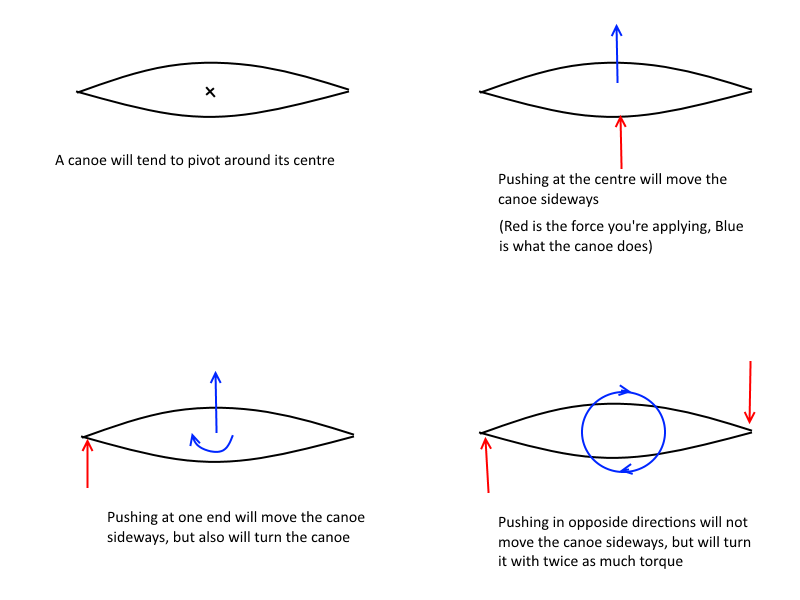
The torque produced is proportional to the distance from the pivot point.  That is, if you push with the same force at a distance twice as far from the pivot point, then the torque is doubled.  That’s why it’s easier to loosen a bolt with a long wrench than with a short one.

Equivalency Vectors

Dealing with tonnes and tonnes of vectors is hard.  Often times though we can replace lots of vectors with one vector.  Let’s say that you have a bunch of people pulling or pushing on an object to move it.  For the purpose of analysis, you could replace all the forces that people are applying with a single force that represents the sum of their effort.  As long as the equivalent vector applies the same net force as all the individual efforts, and the same torque as all the individual efforts, you can concentrate only on the one vector to make the math easier.

Forces on the Boat – CE and CLR

The Sail, and Centre of Effort (CE)

The wind blowing across a sail generates a force on the sail.  This force is part forwards, part sideways.  Got it?  Good!  Hey, that was easy!

While the sail actually has lots of little forces pushing against the sail all over it (perpendicular to the sailcloth), you can imagine it as one big force.  This force (which we’ll call the effort) is applied about 1/3 the way along the sail and about 1/3 the way up the mast (in other words, not quite the middle, but pretty close to where the sail is “baggiest”).  The point at which the force is pushing is called the Centre of Effort, or CE.
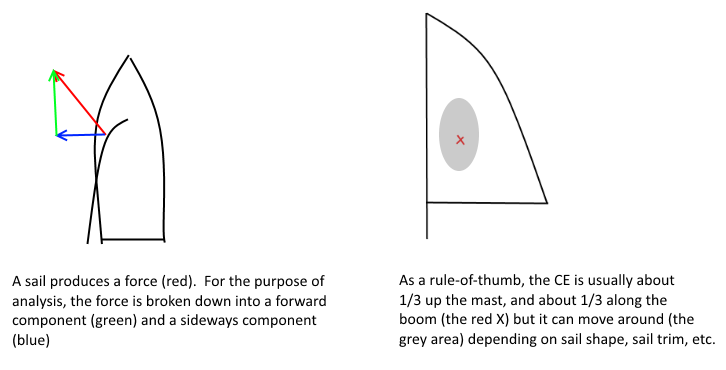
The direction of effort is (roughly) perpendicular to the sail at the sail’s deepest point.  It generally points forwards some amount, and to leeward some amount.  A fuller or tighter sail can change the direction somewhat, but it’s okay to think of  it as pretty much perpendicular to the sail.

CE on Boats with 2+ Sails

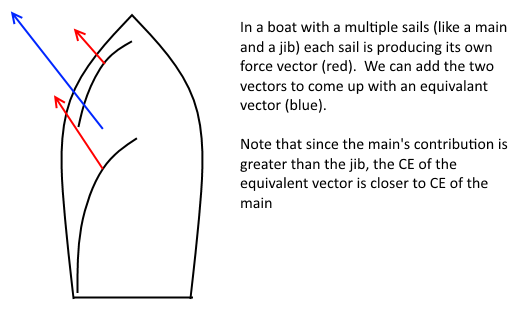
The above talks in terms of CE in a boat with a single sail.  The principals are the same for a boat with a jib.  Some points before we take a look at double-handers:

  • There are two sails generated forces — we’ll have to add them up
  • The main is usually bigger than the jib, and usually generates more force — our combined CE will be dominated by the main’s contribution
  • The mast is usually a bit farther back on double-handers

This means that the force generated by the main is a bit farther back in the boat, but we have a new force generated by the jib forward.  The jib force is generally smaller than the main.  The sum of these two forces is between the two individual forces, but closer to the main force.

The total CE generated by the sails will generally be close to the mast, but a little bit behind.
Some boats have a third sail that goes in front of the jib called the spinnaker (typically only raised when going downwind).  This sail also generates force and the CE will be moved forward farther when the spinnaker is raised.  The same principals apply on boats with multiple masts, or multiple sails.

The Foils, and Centre of Lateral Resistance (CLR)

This one is not quite as intuitive as the sail(s).

Picture a canoe.  The canoe is easy to push forwards/backwards, but tougher to push sideways, right?  The shape of the canoe (narrow in one dimension, wide in the other) resists the sideways motion.  This is called “lateral resistance”.

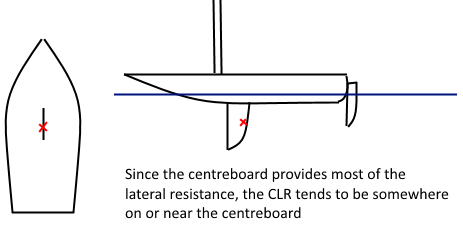
Sailboats have hulls that produce some lateral resistance, and the rudder produces some as well (when it’s straight), but the majority of the lateral resistance comes from the centreboard (or dagger board, or keel, or whatever you call the “fin” that sticks down into the water — I’ll just call it the centreboard).  A few sailboats (like the Hobie 16) don’t have boards, so the hull is shaped to provide extra lateral resistance.  For the purpose of this analysis, we’re talking about boats with boards.

Just like we were able to take all the little forces on the sail and come up with an equivalent force applied at the centre of effort, we can take all the little lateral resistances and do our analysis based on a single force generated at the “centre of lateral resistance” or CLR.  Since we’ve already mentioned that the centreboard is providing most of the lateral resistance, you won’t be surprised to learn that the CLR for the whole boat tends to be pretty close to the middle of the centreboard.
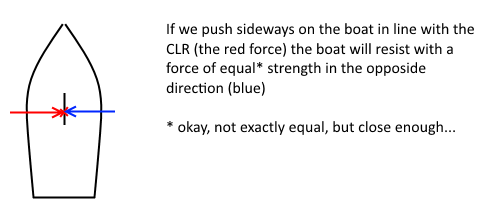
Sailboats generally produce a lot of lateral resistance, much more so than a canoe.  They make so much, that we often “cheat” in our analysis and say that the boat doesn’t move sideways at all.  If we apply 100 pounds of sideways force to a sailboat, we’ll say that the boat produces 100 pounds of resistance, and doesn’t move sideways.  It actually does move sideways a little bit, but for the purpose of this write up we’ll say it doesn’t.
A note on terminology — “foils” or hydrofoils are the thin blades move through the water and generate forces.  In the boats we’re talking about, the centreboard and rudder are the foils.  There are a few types of boats which have horizontal or angled foils.  Rather than produce a force to resist the boat moving sideways these produce an “upwards” force to help lift the hull out of the water.  You can get some pretty amazing results with this, but when this page talks about “foils” we’re taking centreboard and rudder, not lifting foils.

Drag

Just like a boat resists moving sideways, the hull and foils of a boat also resists moving forwards or backwards.  This resistance is called “drag”.  Drag is usually much less than lateral resistance though.  (Warning: math incoming) Drag tends to increase proportionally to the square of speed of the boat.  That is to say, a boat going twice as fast generates four times as much drag, everything else being equal.

In a moment we’ll see a sail generate a forward force on the boat.  We know that an unbalanced force causes something to accelerate (Newton’s 2nd law).  As the boat speeds up, the drag grows until the forward force equals the drag force (at our top speed).  Later on in the class, we’ll be (I assume) talking about things we can do to reduce drag to increase our top speed.  For now though, our analysis does not take drag into account.

Applying CE/CLR

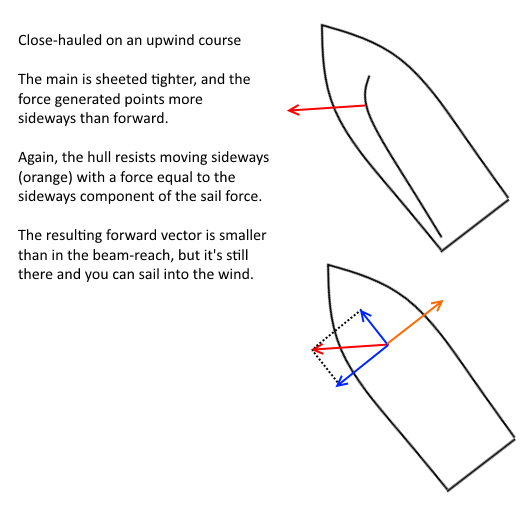
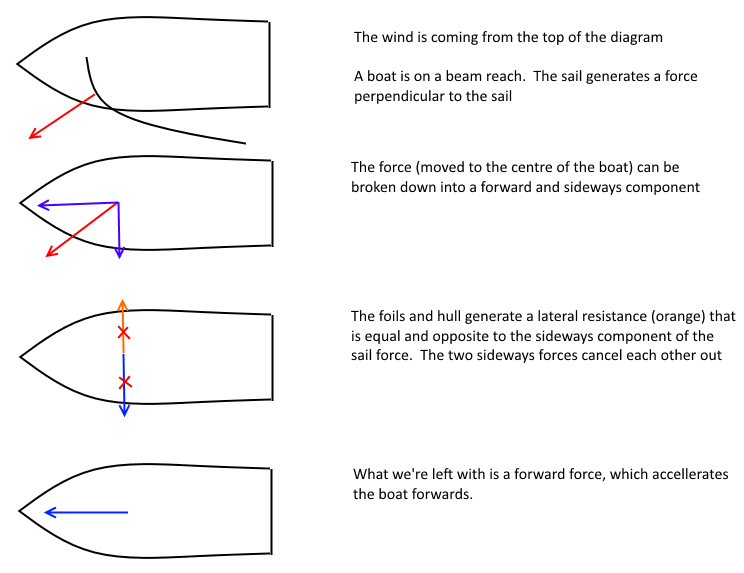
Analysis without considering torque — how does a boat sail  upwind?

We’re going to first consider a beam reach (we’re sailing perpendicular to the wind) because it makes more intuitive sense, at least to me.

For the purpose of this analysis, we’ll consider all forces as if they act on the “middle” of the boat, without generating torque.  That part comes later…
Adding Torque to the Equation

Terms to know – weather helm and lee helm

I’d like to talk about two terms we’ll be using.  For some reason, the direction the wind is coming from is sometimes called “wind” (as in “windward”) but it’s also sometimes called “weather”.  The direction the wind is blowing to is “lee”.  The various forces on the boat might be exerting a torque on the boat, trying to turn it into the wind (“weather helm”) or away from the wind (“lee helm”).  Most boats are designed to have a small bit of weather helm when sailed properly.  This will turn the boat into the wind and stop the boat if the skipper falls off or lets go of the rudder, or something.

Torque to roll the boat

Probably the easiest effect of torque to understand is how a boat stays upright.  That’s because we’ve all hiked out on a boat, and we’ve all experienced the effects of moving around while hiking.

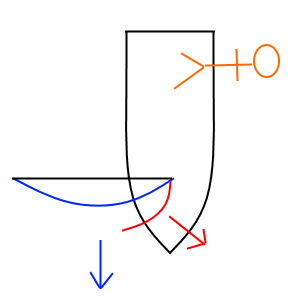
We have the wind pushing on the sail.  For this analysis, we’re looking at just the “sideways” part of how the wind pushes, and not the forward part.  The wind is pushing some distance up the mast, at CE.  Counter to this, we have the lateral resistance in the opposite direction somewhere below the waterline.  Remember our canoe example at the top of this post?  The two forces pushing in opposite directions some distance apart are working together to torque the boat around a pivot point.  In the diagram below, these forces (red) are producing the red clockwise torque around the pivot (purple X).  This is the torque which will heel the boat and capsize if you don’t do anything to stop it

To counter that torque, we need to exert an equal amount of torque in the counter-clockwise direction.  We do this by hiking.  Gravity exerts a force on our body, which is transferred to the boat using our legs as levers.  The heavier we are (the more downward force) or the taller we are (the farther away from the pivot the force is applied) the more torque is generated.  Jason uses this as an excuse to have a second helping of desert.  You want to apply just the right amount of torque such that the boat stays flat.
Let’s look what happens when the boat heels.

First, there is less sail area presented to the wind, so the sideways force (red arrows) become smaller.  Second, the CE moves “down” toward the waterline as the mast tilts.  The CLR moves “up” as well.  All this means the red vectors (which are smaller anyway) are vertically closer to the pivot point, providing less torque.  The net result — less hiking force is needed to keep the boat steady.

In strong winds, even the tall heavy sailors can’t generated enough torque to keep the boat flat.  Most of the time, you’ll see a fleet of Lasers sailing along, all with a bit of heel according to the skipper’s ability to generate righting force.  Good Laser sailors know that sheeting out to spill some wind (reducing the size of the red vectors) results in a flat boat and less drag, and generally go faster than the kids who try to hold all the wind in their sail and heel too much.  To put it another way, the good sailors will generate as much torque with their body as they can, and then adjust their sail to their body.  The other sailors will try to generate as much sail power as they can and then wrench their body trying to tame it (and fail to do so).

If you get a chance to watch Steve Harrington on the water at a KSC club race, he’s a perfect example.  The guy’s 145 pounds, 5’6″ and his Laser is dead flat in even the strongest winds.  He’s also winning every race.

Torque Affects of CE and CLR on weather helm and lee helm

Let’s look at the boat from the top.  This is similar to what we did when we looked at how we sail upwind, but now we’ll look at the torques the different forces generate.
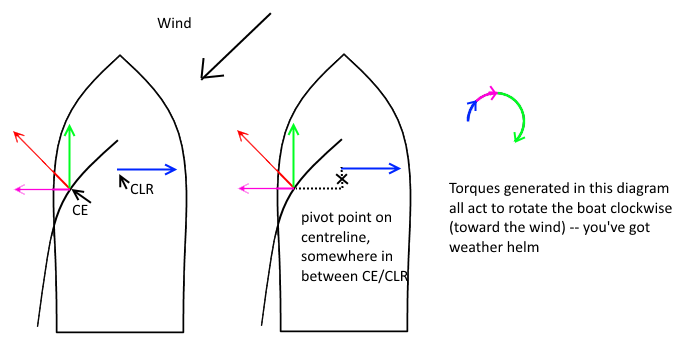
The boat will tend to pivot at some point between the CE and CLR.  The two sideways components (blue and purple) will together torque the boat in one direction.  If CE is behind CLR, then they’ll be rotating the boat into the wind (weather helm).  If CE is in front of CLR, then they’ll rotate the boat away from the wind (lee helm).  If they are perfectly lined up with each other, then they won’t be torquing the boat at all.  The forward component of the sail (green) will however torque the boat (weather helm), even if CE and CLR are perfectly in line, since it’s pushing forwards off-centre to the pivot point

Moving CE/CLR to steer

Let’s take a look what happens to CE and CLR around the boat.

Let’s say you were to move CE forward in the boat.  What would happen?  The sideways components (purple and blue, above) wouldn’t have has much leverage around the pivot point, and you’d have less weather helm.  If you move CE so far forward that it’s in front of CLR, you’re actually generating lee helm with those sideways forces.

Now what about that green “go forward” component?  If you roll your boat to windward (that is, towards the right side of the diagram above) then you can move your CE to the point where it is directly above CLR.  This would eliminate the green torque component.

How would you move CE forward (or back) in the boat?  Sheeting the main in would move CE farther back and in towards the centreline.  Sheeting out would move CE forward, but away from the centreline.  Sitting farther forward in the boat would tilt the mast forward (and tilt the centerboard backwards) to move CE/CLR forward/back.  Hiking the boat to windward would move CE towards the centreline, and heeling to leeward would move it away from the centreline.

So to steer without a rudder you would:

  • To turn into the wind, generate weather helm
    • move back in the boat to move CE backwards behind CLR (more blue/purple torques)
    • stop hiking so hard, let the boat heel to leeward to move CE out and away from CLR (more green torque)
    • sheeting in would increase force from sideways components (more blue/purple force, thus more torque), move CE back (more blue/purple torque) but would also move CE in towards the centreline (less green torque).  Sheeting in is usually a net gain in weather helm
  • To turn away from the wind, generate lee helm
    • move forward in the boat to move CE forward ahead of CLR
    • hike harder, heel the boat to windward to move CE in closer to the centreline of the boat (less green torque)
    • sheet out to move CE ahead (reduces blue/purple torques, but increase green torque).  Sheeting out is usually a net gain in lee helm

On a double-handed boat, you can also use the jib.  Picture the scenario where you let one sail (either the main or the jib) do all the work, while the other one just flaps around

  • if you’re using the jib to generate all your power, the CE is very far ahead of the CLR, and you turn away from the wind
  • if you’re using the main to generate all your power, the CE is very far behind the CLR, and you turn towards the wind

Thus, it’s quite easy for a single sailor to sail a double-hander without a rudder — let one sheet loose, and yank on the other.  You can play with how much of each sail you’re applying until you find a balance that keeps you straight.

How a Sail Generates Forces

I’m not touching this one.

There are countless articles written about how a sail generates force, many of which contradict each other.  Most resources you’ll find online either

  • oversimplify things to the point at which they are flat out wrong
  • present part of the physics while ignoring others, leaving questions unanswered
  • insult people who present a different model of how a sail works
  • all of the above
  • all of the above, and then they claim that you’re just not smart enough to understand

In other words, it’s the airfoil teaching effect:
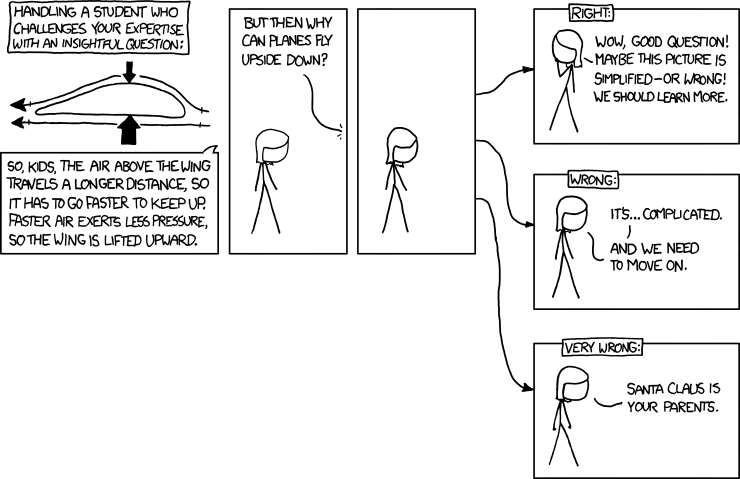
(image used with permission, original source https://www.xkcd.com/803/)

In my humble opinion, knowing how to use the force is more important than knowing the details of how it is generated.

Turbulent and Laminar Flow

I will speak briefly on turbulence.  A fluid (air, water, etc) will tend to flow in nice straight lines (laminar flow).  When it encounters an object, it has to go around the object.  If the object is fairly small, is nice and smooth, and allows for gradual flow around the object, you can have laminar flow around it.  If the object forces abrupt changes in the direction of the fluid, you create turbulence, and eddies or swirlies are introduced into the system.
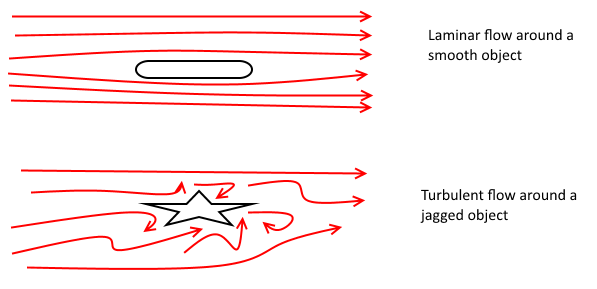
When laminar flow is established can be harnessed to generate the sail and foil forces with minimal drag.  When a flow becomes turbulent the amount of force we can generate drops significantly, and the amount of drag increases.  To put it another way, we’d like all the fluids moving around our boat to have laminar flow if possible.

How do you know you have laminar flow?  Look at the tell tales on your sail.  If they are streaming backwards, they’re getting caught in the laminar flow as the wind blows across your sail.   Great!  If your tell tales are spinning around, flapping forwards and then back, or other erratic behaviour, then they are getting caught in one of the eddies, which indicates you have turbulent flow.  Turbulent flow means your sail is not generating as much power, and there is more drag on your rig.

We can’t see tell tales on our foils, but we can look at the water behind the boat.  If the water in our wake is relatively smooth, then then foils are not generating much turbulence.  If our wake is full of bubbles, and little whirlpools, then its and indication that our hull is dragging significantly.  Reducing hull drag is beyond the scope of this write-up, but try sitting farther forward in the boat and using less rudder if possible.

Apparent Wind

True wind is what the wind is doing relative to the ground (or water, or other stationary point).  You may be in a lull, or a gust, or just steady wind.  Whatever the case, if the wind is blowing 10 knots from the North relative to the surface, then that is the true wind at this point in time.

Induced wind or boat wind is the wind that’s created by moving across the surface.  If the true wind is dead still, but you’re riding a bicycle at 30 km/h then you “feel” a wind on your face as if it’s blowing 30km/h right at you.  That’s induced wind — wind created by your motion over the ground.

Apparent wind is the combination of the two.  Let’s say the wind was blowing at 10 km/h and you were riding a bike at 30 km/h directly into the wind.  You would “feel” 40 km/h (10 km/h true wind, plus 30 km/h induced wind).  If you were biking away from the wind, you would feel 20 km/h.  If you were biking sideways to the wind, you’d “feel” the wind come at you at about 32km/h from and angle about 32 degrees.

When you are travelling slow, the induced wind is small, and apparent wind is pretty close to true wind.  When you are travelling very fast the apparent wind becomes closer to the induced wind.

You’re sails operate on what they feel — the apparent wind.  So if you’re at a standstill on a beam reach, your sails “feel” the true wind coming from directly beside you.  As your speed increases, you’ll be generating more induced wind.  This will make the wind “appear” to come from more in front of you.  As you speed up, the boat may move from a beam reach to a close reach, even to close hauled just be speeding up.

Another example is gybing a Laser in strong wind.  You want to be going as fast as possible when you gybe.  If the wind is blowing at 20 knots, and you’re going 5 knots in the direction of the wind, then there’s 15 knots of apparent wind coming behind you.  Tough as hell to gybe that.  But, if you’re going 15 knots downwind, then there’s only 5 knots of apparent wind coming behind you.  That’s a walk in the park!  So catch a wave, get up on a plane, do whatever you need to do to speed up that boat heading into that gybe!

Side note – Some boats can sail faster than the true wind on reaches.  That’s because it’s not the 5 knots of true wind that is operating on the sail, it’s the 20 knots of apparent wind that the sail is using.  The 29er, for example, will sail at a speed of about 18 knots on a broad reach in 12 knots of wind, and you’re actually “tacking” through the apparent wind when you gybe.

 

Advances Sailing Skills, May 13, 2017

The second session was a brief review of points of sail, and an introduction to roll tacks.  Lasers were rigged and launched from the end of the ramp.  No capsizes!

Forecast was 6-8 knots of wind from S, however observed was maybe about 4 from SW with a couple of gusts in 6 knot range from SE.

Course set was initially intended to be a 2-bouy beam reach course, but ended up being closer to a close hauled on one leg, and broad reach down the other.  When headers hit, it could’ve almost been a windward-leeward course (tack on headers, my friends!)

Points of sail, reviewed

The instructors reviewed points of sail so as to better communicate with the students on the water.  Also refreshed were terms “heading up” (turning towards the wind), and “bearing off” (turning away from the wind). https://en.wikipedia.org/wiki/Point_of_sail

Rock & Rollin’

Let’s talk roll tacks.  First, I’ll write a wee bit about how the instructors’ described roll tacks.  I assume this is the “CANSail” way of teaching roll tacks.  Then we’ll talk briefly about how other resources talk about roll tacks.

The CANSail way to think about roll tacks

Roll tacks were described in terms of using heel to facilitate steering through the tack, reducing the use of rudder (and therefore losing less speed through the tack).  The description was given in 3 steps:

  1. Initiate the tack.  Heel the boat to leeward by moving towards the windward side.  This causes the boat to head up towards irons.  You can use the rudder a bit, but the goal is to start the tack with little to no rudder use.
  2. When the sail starts to luff, roll the boat hard to windward.  The boom will eventually cross the boat and fill on the other side.
  3. Cross the boat and hike the boat flat on the new tack (note to self — I was consistently moving across the boat too early, before the sail filled on the new tack.  Remember this for next time…)

Once the basic motions are nailed, here’s a bit more to think about:

  • The heel to windward (step 2) is a big roll.  You’ll roll it farther than you did in step 1.  Your butt might be in the water, and the dagger board may start to come out of the water.  The side of the boat may become submerged.
  • Keep the sail sheeted in tight (close-hauled position) during the whole tack.


The Non-CANSail Way to think about roll tacks

When you’re watching YouTube, reading books, or checking out blogs, roll tacks are spoken about less from a “steering” perspective, and more from a “wind” perspective.  The idea is that the rolling motion (steps 2 and 3, as the instructors described) will move the sail through the air as the boat heels, keeping pressure in the sail and driving the boat forward.  The faster and harder you roll the boat, the more air is forced into the sail, and the faster you move.

Particularly in light wind, the pressure generated by a fast roll can be greater than the wind normally exerts on a close reach.  You can actually move the boat faster by repeatedly roll tacking than by sailing straight (when racing, this is against the rules — you’re allowed to roll tack, but you are not allowed to exit the tack with speed “greater than it would have been in the absence of a tack”.  Rule 42.3b)

I mention this because lots of resources on the Internet (and in print) talk about roll tacks purely from a “keep wind in your sails” perspective.  Some resources also mention helping you steer, but in the more in the context of as added bonus to the main goal of keeping your sails full.  The CANSail instruction is the only one I’ve seen that has spoken about it purely from a steering perspective, but the instructors know what they’re doing better than I, so listen to them.

To show the different perspectives on roll tacks, here are some resources showing excellent sailors demoing the tacks each with their own emphasis:

  • Steve Cockerell (Former Laser Masters’ world champion and owner of Rooster Sailing) demonstrates roll tacking in light wind https://www.youtube.com/watch?v=RRLVHIuMFFo.  He doesn’t seem to use much leeward heal to start the tack, and instead uses a fair amount of rudder.  Note how far he rolls the boat to windward (looks like it’s getting close to 45 degrees)
  • Jon Emmett (who’s coached a couple of Olympic teams) demonstrates some ridiculously smooth tacks.  You can see him move in slightly to roll the boat to leeward before his big windward roll, although he doesn’t mention it.  https://www.youtube.com/watch?v=BR6ec_nPWbw
  • Olympic Gold medallist Shirley Robertson doesn’t roll the boat through the tack as much as the above videos, and instead emphasizes body position (positioning of hands and feet through the manoeuvre).  The number of steps she uses is a bit daunting for me.  https://www.youtube.com/watch?v=hF2eK6sCOrI
  • Fred Strammer (US collegiate sailor) does a ridiculously strong roll to flatten the boat when coming out of the tack.  https://www.youtube.com/watch?v=Q3hQG63J508&t=1m43s

All this is to illustrate that different top sailors seem to think that different aspects of the tack are worth focusing on.  I’m going to listen to the instructors and focus on the steering via heel throughout the tack, but be aware that the resources you find online may highlight other aspects of the technique.

One final video, if you’ll allow me.  This is from the 2015 Laser World Championship (in Kingston, Ontario that year) where Australian Tom Burton (who went on to win Olympic Gold in 2016) was in the lead over American Chris Bernard.  Tom knew Chris could not pass him as long as they were on the same tack.  Chris knew he couldn’t catch Tom as long as they were on the same tack.  Tom would roll tack to be on the same tack as Chris (and in front of him) to “cover” Chris.  Chris would immediately roll tack to be on the opposite tack to try to pass Tom.  https://www.youtube.com/watch?v=zOHySbcp5gs&t=5m40s

Advanced Sailing Skills – May 8, 2017

The first class of ASS (todo — think of better acronym) was held on May 8, 2017.  Topics covered were an overview of what will be taught in the course, as well as rigging Albacores and Lasers.  Rigging was covered at a more in-depth level than in LTS, with sail controls pointed out and explained.

(parts of the sail mnemonics: “The part at the back is not the tack, so that should be a clue [clew].”  Also “There once was a leach [leech] who got a clue [clew] when his foot stepped on a tack and he laughed [luffed] his head off”)

Albacore

When hoisting the jib, the wire running inside the luff of the jib will start carrying all the tension and the forestay becomes loose.  To make hoisting easier, use the jib sheets (or some other leverage) to pull the forestay taught.  This will reduce tension on the wire inside the jib, and allow you to hoist it tighter.

Some Albacores have a jib tie down to attach the tack of the jib to the forestay bracket.  This prevents the tack of the jib from running up the wire and creating wrinkles in the luff.

The Albacore controls pointed out were the outhaul (attaching to the clew, to tension the foot), the boom vang (pulling the boom down, to tension to the leech) and the cunningham (pulling the tack down, to tension the luff).  Instructors recommended loosening the vang in higher winds.  This allows more twist at the top of the sail, and will spill wind from there (see “Notable differences” below).  They also recommend tightening cunningham in high winds to depower the sail.

Things that are often forgotten about Alabacore:

  • tie down the jib tack
  • cleat the outhaul
  • secure the shock cord on the transom flaps so they don’t open when you get into the water
  • check if your auto-bailers are open or closed

Laser

Don’t put the Laser mast on the ground — sand will get in there, and “grind” against the mast step.  Make sure battens go in the sail before you step the mast (Jason-often-forgets-this #1).  When rigging the boom, check that the mainsheet is secured to the block with a stopper knot, rather than a bowline.  This will make it easier to sheet block-to-block on upwind legs or in high winds.  Figure 81 of the Laser Rigging Manual shows how to do this, but someone at the club likes to undo the stopper knot and tie a bowline instead.  Don’t forget the drain plug (Jason-often-forgets-this #2).  When attaching the rudder and tiller, the tiller goes underneath the traveller (otherwise the traveller will get caught on the tiller — Jason-often-forgets-this #3)

In a Laser, the luff of the sail is (slightly) curved, while the mast is straight.  This induces “bagginess” to the sail (lots of power, but low pointing ability).  When you are going upwind, or are becoming overpowered, you want to flatten the sail to reduce bagginess.  You can flatten by sheeting in all the way (“block-to-block”) and by using the boom vang.  This will tighten the leech of the sail, pulling the tip of the mast down (the top part of the mast is nice and flexible) which better fits the sail, and lets the sail flatten out.  Tightening the outhaul (and, to a lesser extent, the cunningham) will also help flatten the sail.  The depowering strategy in a Laser, especially upwind, is to get as flat a sail as you can and then sheet out to spill wind.

It was pointed out that a Laser will often get the mainsheet caught on the corner of the transom when gybing.  Yanking hard on the sheet as you start the gybe can help reduce the chances of this (but it’s not a perfect solution).  Doug Peckover describes how the hot-shots use their tiller extension to unhook a snagged mainsheet in his blog.  (Jason has been doing this for about a year, and it seems to work well enough.)  Additionally, it was suggested on the Internet that the tiller extension could preemptively be used in this manner to prevent the thing from being caught in the first place, but this technique has yet to be tried.  Jon Emmett recommends sheeting the boom in a significant amount before gybing.  This reduces the amount of slack line that can get caught around the transom.  Also, he does roll-gybes which causes any loose mainsheet to stay “up in the air” rather than drag in the water and be pulled around the back of the boat, but that’s a discussion for another day…

Notable differences

In an Albacore, excess power in high winds is spilled by loosing the vang to induce twist to the main.  This lets wind spill from the top of the sail.  In a Laser, excess power is typically dealt with by sheeting out slightly.  This requires a tight vang.  Without a vang, the Laser boom will tend to go “up” rather than “out” as the top of the mast straightens.  This leads to more power in the sail (rather than less) and often results in a swim.  A tight Laser vang keeps the boom down and mast bent, so when you let out the mainsheet, the boom goes “out” rather than “up”.

Downwind, in both boats, nice loose controls allow for large draft in the sails which let’s you generate a lot of power, since you’re not worried about pointing.