Tag Archives: racing

Advanced Sailing Skills, – May 15, 2017

Introduction

This off-the-water class was concerned with the physics of sailing.  Tom did his “Theory from Hell” lecture (thanks, Tom!) and Reese spoke about how to apply the forces generated to the actual boat.

I’m going to present the information in a bit of a different order than was listed in the class.  I’ll talk about the forces on a boat first, and talk (briefly) about how the sail force is generated later.  We’ll discuss laminar flow, turbulent flow, and finally apparent wind.

But first… ready to take a review of Grade 12 Math?

Vector Math

A scalar (like the number 8) is a mathematical representation something that has magnitude (or size, or quantity).  A vector is a mathematical representation of something that has magnitude and a direction.  Forces on an object can be represented by vectors that are made up of how strong the force is (the magnitude) and which direction the force is pushing (the direction).

On diagrams, force vectors applied to an object are often drawn as arrows.  The direction of the arrow shows the direction in which the force is applied.  The placement of the arrow shows where the force is applied.  The length of the arrow shows how much force is applied (the longer the arrow, the more force).

We use vectors in sailing to understand how forces affect the boat, how apparent wind changes as the boat moves, and to understand how the heck we can sail “into” the wind.  Don’t worry, we won’t be doing number-crunching.  We’re more concerned with “push here to turn left”, not “calculate how fast you turn left when you push here exactly this hard”

Breaking down and summing vectors

Just like scalars can be added together (8 + 6 = 14) vectors can be added.  If the vectors are in the same direction, adding them up is just like adding numbers (if the wind is blowing 6 knots from the north, and speeds up by 6 knots from the north, then the result is that it is blowing 12 knots from the north).  When vectors have different direction, the adding is not quite as simple (if the wind is blowing 6 knt from the north, then speeds up by 6 knts from the east, then the result is 8.5 knots from the north-east).  We won’t be doing any number crunching or trigonometry, it’s just something to be aware of.

Just like adding two vectors into one vector, a vector can be broken down into two (or more) smaller vectors called components.  In the above example, a 8.5 knot wind from the NE can be thought of as “6 knots from the N and 6 knots from the E”.  Vectors are usually broken down into components that are perpendicular to each other (like N and E), but you can break them down into components of any direction as long as they add up to the same thing.

We’ll see summing and breaking down vectors more as we analyze how the foils counter the sail and how the apparent wind works.

Torque

In the real world, when we push or pull on something off-centre, it tries to turn.  Let’s take the example of a canoe floating beside a dock.  If we push on the middle of the canoe, it moves sideways.  If we push on one end, it moves sideways, but also tries to turn.  This turning force is called “torque”.  If we want to turn the canoe only (without it moving sideways) than we can push on both ends of the canoe in opposite directions.  The “sideways” parts of the pushes cancel each other out, but the torque from each push is added.
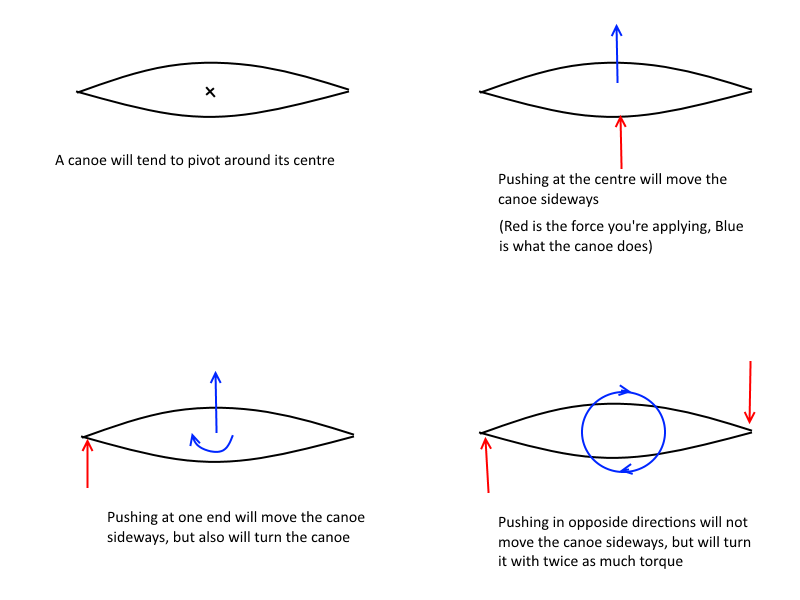
The torque produced is proportional to the distance from the pivot point.  That is, if you push with the same force at a distance twice as far from the pivot point, then the torque is doubled.  That’s why it’s easier to loosen a bolt with a long wrench than with a short one.

Equivalency Vectors

Dealing with tonnes and tonnes of vectors is hard.  Often times though we can replace lots of vectors with one vector.  Let’s say that you have a bunch of people pulling or pushing on an object to move it.  For the purpose of analysis, you could replace all the forces that people are applying with a single force that represents the sum of their effort.  As long as the equivalent vector applies the same net force as all the individual efforts, and the same torque as all the individual efforts, you can concentrate only on the one vector to make the math easier.

Forces on the Boat – CE and CLR

The Sail, and Centre of Effort (CE)

The wind blowing across a sail generates a force on the sail.  This force is part forwards, part sideways.  Got it?  Good!  Hey, that was easy!

While the sail actually has lots of little forces pushing against the sail all over it (perpendicular to the sailcloth), you can imagine it as one big force.  This force (which we’ll call the effort) is applied about 1/3 the way along the sail and about 1/3 the way up the mast (in other words, not quite the middle, but pretty close to where the sail is “baggiest”).  The point at which the force is pushing is called the Centre of Effort, or CE.
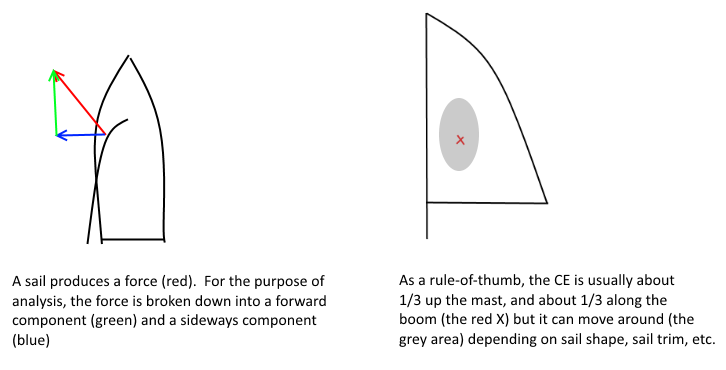
The direction of effort is (roughly) perpendicular to the sail at the sail’s deepest point.  It generally points forwards some amount, and to leeward some amount.  A fuller or tighter sail can change the direction somewhat, but it’s okay to think of  it as pretty much perpendicular to the sail.

CE on Boats with 2+ Sails

The above talks in terms of CE in a boat with a single sail.  The principals are the same for a boat with a jib.  Some points before we take a look at double-handers:

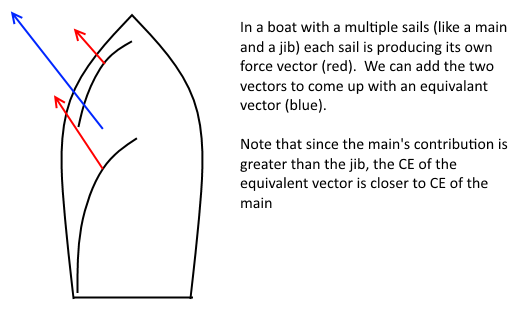
  • There are two sails generated forces — we’ll have to add them up
  • The main is usually bigger than the jib, and usually generates more force — our combined CE will be dominated by the main’s contribution
  • The mast is usually a bit farther back on double-handers

This means that the force generated by the main is a bit farther back in the boat, but we have a new force generated by the jib forward.  The jib force is generally smaller than the main.  The sum of these two forces is between the two individual forces, but closer to the main force.

The total CE generated by the sails will generally be close to the mast, but a little bit behind.
Some boats have a third sail that goes in front of the jib called the spinnaker (typically only raised when going downwind).  This sail also generates force and the CE will be moved forward farther when the spinnaker is raised.  The same principals apply on boats with multiple masts, or multiple sails.

The Foils, and Centre of Lateral Resistance (CLR)

This one is not quite as intuitive as the sail(s).

Picture a canoe.  The canoe is easy to push forwards/backwards, but tougher to push sideways, right?  The shape of the canoe (narrow in one dimension, wide in the other) resists the sideways motion.  This is called “lateral resistance”.

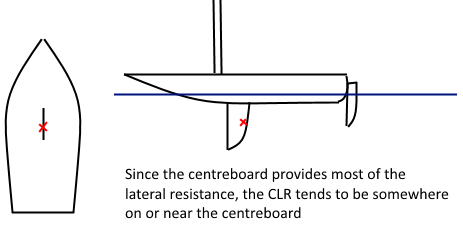
Sailboats have hulls that produce some lateral resistance, and the rudder produces some as well (when it’s straight), but the majority of the lateral resistance comes from the centreboard (or dagger board, or keel, or whatever you call the “fin” that sticks down into the water — I’ll just call it the centreboard).  A few sailboats (like the Hobie 16) don’t have boards, so the hull is shaped to provide extra lateral resistance.  For the purpose of this analysis, we’re talking about boats with boards.

Just like we were able to take all the little forces on the sail and come up with an equivalent force applied at the centre of effort, we can take all the little lateral resistances and do our analysis based on a single force generated at the “centre of lateral resistance” or CLR.  Since we’ve already mentioned that the centreboard is providing most of the lateral resistance, you won’t be surprised to learn that the CLR for the whole boat tends to be pretty close to the middle of the centreboard.
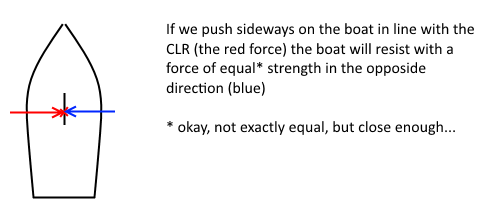
Sailboats generally produce a lot of lateral resistance, much more so than a canoe.  They make so much, that we often “cheat” in our analysis and say that the boat doesn’t move sideways at all.  If we apply 100 pounds of sideways force to a sailboat, we’ll say that the boat produces 100 pounds of resistance, and doesn’t move sideways.  It actually does move sideways a little bit, but for the purpose of this write up we’ll say it doesn’t.
A note on terminology — “foils” or hydrofoils are the thin blades move through the water and generate forces.  In the boats we’re talking about, the centreboard and rudder are the foils.  There are a few types of boats which have horizontal or angled foils.  Rather than produce a force to resist the boat moving sideways these produce an “upwards” force to help lift the hull out of the water.  You can get some pretty amazing results with this, but when this page talks about “foils” we’re taking centreboard and rudder, not lifting foils.

Drag

Just like a boat resists moving sideways, the hull and foils of a boat also resists moving forwards or backwards.  This resistance is called “drag”.  Drag is usually much less than lateral resistance though.  (Warning: math incoming) Drag tends to increase proportionally to the square of speed of the boat.  That is to say, a boat going twice as fast generates four times as much drag, everything else being equal.

In a moment we’ll see a sail generate a forward force on the boat.  We know that an unbalanced force causes something to accelerate (Newton’s 2nd law).  As the boat speeds up, the drag grows until the forward force equals the drag force (at our top speed).  Later on in the class, we’ll be (I assume) talking about things we can do to reduce drag to increase our top speed.  For now though, our analysis does not take drag into account.

Applying CE/CLR

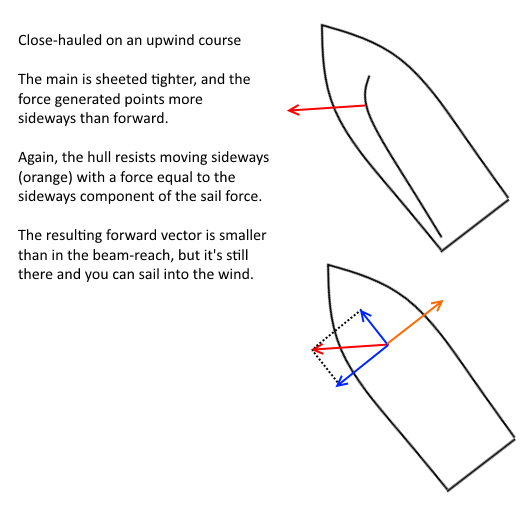
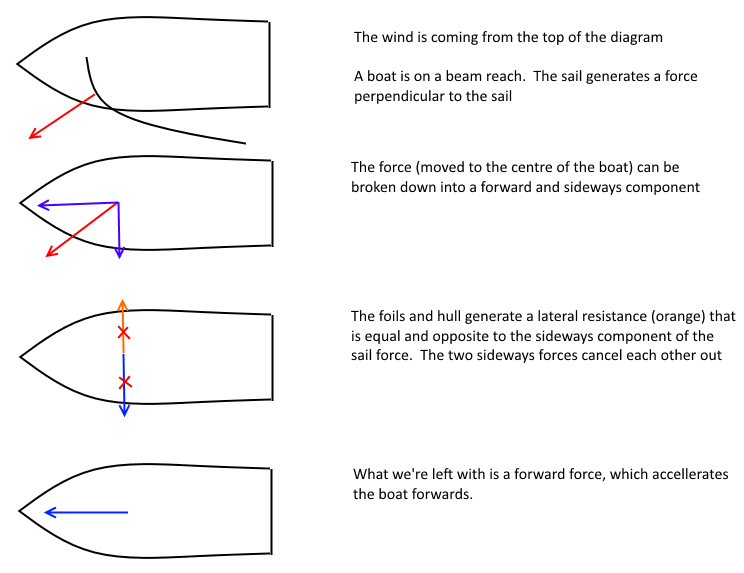
Analysis without considering torque — how does a boat sail  upwind?

We’re going to first consider a beam reach (we’re sailing perpendicular to the wind) because it makes more intuitive sense, at least to me.

For the purpose of this analysis, we’ll consider all forces as if they act on the “middle” of the boat, without generating torque.  That part comes later…
Adding Torque to the Equation

Terms to know – weather helm and lee helm

I’d like to talk about two terms we’ll be using.  For some reason, the direction the wind is coming from is sometimes called “wind” (as in “windward”) but it’s also sometimes called “weather”.  The direction the wind is blowing to is “lee”.  The various forces on the boat might be exerting a torque on the boat, trying to turn it into the wind (“weather helm”) or away from the wind (“lee helm”).  Most boats are designed to have a small bit of weather helm when sailed properly.  This will turn the boat into the wind and stop the boat if the skipper falls off or lets go of the rudder, or something.

Torque to roll the boat

Probably the easiest effect of torque to understand is how a boat stays upright.  That’s because we’ve all hiked out on a boat, and we’ve all experienced the effects of moving around while hiking.

We have the wind pushing on the sail.  For this analysis, we’re looking at just the “sideways” part of how the wind pushes, and not the forward part.  The wind is pushing some distance up the mast, at CE.  Counter to this, we have the lateral resistance in the opposite direction somewhere below the waterline.  Remember our canoe example at the top of this post?  The two forces pushing in opposite directions some distance apart are working together to torque the boat around a pivot point.  In the diagram below, these forces (red) are producing the red clockwise torque around the pivot (purple X).  This is the torque which will heel the boat and capsize if you don’t do anything to stop it

To counter that torque, we need to exert an equal amount of torque in the counter-clockwise direction.  We do this by hiking.  Gravity exerts a force on our body, which is transferred to the boat using our legs as levers.  The heavier we are (the more downward force) or the taller we are (the farther away from the pivot the force is applied) the more torque is generated.  Jason uses this as an excuse to have a second helping of desert.  You want to apply just the right amount of torque such that the boat stays flat.
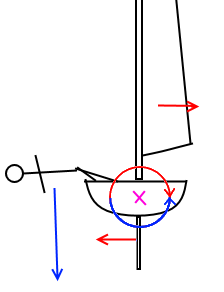
Let’s look what happens when the boat heels.

First, there is less sail area presented to the wind, so the sideways force (red arrows) become smaller.  Second, the CE moves “down” toward the waterline as the mast tilts.  The CLR moves “up” as well.  All this means the red vectors (which are smaller anyway) are vertically closer to the pivot point, providing less torque.  The net result — less hiking force is needed to keep the boat steady.

In strong winds, even the tall heavy sailors can’t generated enough torque to keep the boat flat.  Most of the time, you’ll see a fleet of Lasers sailing along, all with a bit of heel according to the skipper’s ability to generate righting force.  Good Laser sailors know that sheeting out to spill some wind (reducing the size of the red vectors) results in a flat boat and less drag, and generally go faster than the kids who try to hold all the wind in their sail and heel too much.  To put it another way, the good sailors will generate as much torque with their body as they can, and then adjust their sail to their body.  The other sailors will try to generate as much sail power as they can and then wrench their body trying to tame it (and fail to do so).

If you get a chance to watch Steve Harrington on the water at a KSC club race, he’s a perfect example.  The guy’s 145 pounds, 5’6″ and his Laser is dead flat in even the strongest winds.  He’s also winning every race.

Torque Affects of CE and CLR on weather helm and lee helm

Let’s look at the boat from the top.  This is similar to what we did when we looked at how we sail upwind, but now we’ll look at the torques the different forces generate.
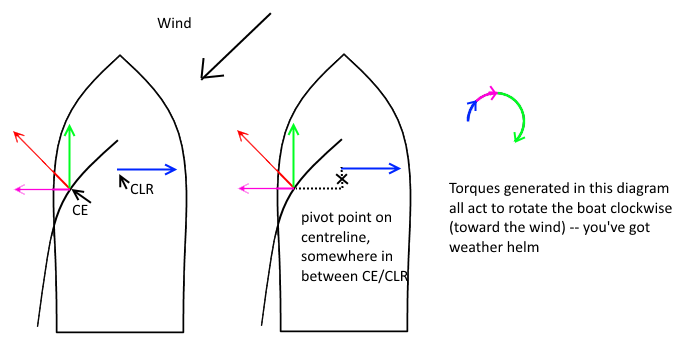
The boat will tend to pivot at some point between the CE and CLR.  The two sideways components (blue and purple) will together torque the boat in one direction.  If CE is behind CLR, then they’ll be rotating the boat into the wind (weather helm).  If CE is in front of CLR, then they’ll rotate the boat away from the wind (lee helm).  If they are perfectly lined up with each other, then they won’t be torquing the boat at all.  The forward component of the sail (green) will however torque the boat (weather helm), even if CE and CLR are perfectly in line, since it’s pushing forwards off-centre to the pivot point

Moving CE/CLR to steer

Let’s take a look what happens to CE and CLR around the boat.

Let’s say you were to move CE forward in the boat.  What would happen?  The sideways components (purple and blue, above) wouldn’t have has much leverage around the pivot point, and you’d have less weather helm.  If you move CE so far forward that it’s in front of CLR, you’re actually generating lee helm with those sideways forces.

Now what about that green “go forward” component?  If you roll your boat to windward (that is, towards the right side of the diagram above) then you can move your CE to the point where it is directly above CLR.  This would eliminate the green torque component.

How would you move CE forward (or back) in the boat?  Sheeting the main in would move CE farther back and in towards the centreline.  Sheeting out would move CE forward, but away from the centreline.  Sitting farther forward in the boat would tilt the mast forward (and tilt the centerboard backwards) to move CE/CLR forward/back.  Hiking the boat to windward would move CE towards the centreline, and heeling to leeward would move it away from the centreline.

So to steer without a rudder you would:

  • To turn into the wind, generate weather helm
    • move back in the boat to move CE backwards behind CLR (more blue/purple torques)
    • stop hiking so hard, let the boat heel to leeward to move CE out and away from CLR (more green torque)
    • sheeting in would increase force from sideways components (more blue/purple force, thus more torque), move CE back (more blue/purple torque) but would also move CE in towards the centreline (less green torque).  Sheeting in is usually a net gain in weather helm
  • To turn away from the wind, generate lee helm
    • move forward in the boat to move CE forward ahead of CLR
    • hike harder, heel the boat to windward to move CE in closer to the centreline of the boat (less green torque)
    • sheet out to move CE ahead (reduces blue/purple torques, but increase green torque).  Sheeting out is usually a net gain in lee helm

On a double-handed boat, you can also use the jib.  Picture the scenario where you let one sail (either the main or the jib) do all the work, while the other one just flaps around

  • if you’re using the jib to generate all your power, the CE is very far ahead of the CLR, and you turn away from the wind
  • if you’re using the main to generate all your power, the CE is very far behind the CLR, and you turn towards the wind

Thus, it’s quite easy for a single sailor to sail a double-hander without a rudder — let one sheet loose, and yank on the other.  You can play with how much of each sail you’re applying until you find a balance that keeps you straight.

How a Sail Generates Forces

I’m not touching this one.

There are countless articles written about how a sail generates force, many of which contradict each other.  Most resources you’ll find online either

  • oversimplify things to the point at which they are flat out wrong
  • present part of the physics while ignoring others, leaving questions unanswered
  • insult people who present a different model of how a sail works
  • all of the above
  • all of the above, and then they claim that you’re just not smart enough to understand

In other words, it’s the airfoil teaching effect:
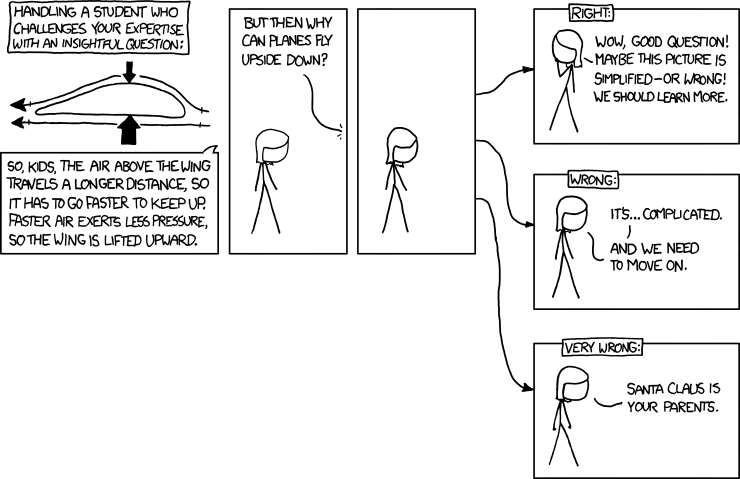
(image used with permission, original source https://www.xkcd.com/803/)

In my humble opinion, knowing how to use the force is more important than knowing the details of how it is generated.

Turbulent and Laminar Flow

I will speak briefly on turbulence.  A fluid (air, water, etc) will tend to flow in nice straight lines (laminar flow).  When it encounters an object, it has to go around the object.  If the object is fairly small, is nice and smooth, and allows for gradual flow around the object, you can have laminar flow around it.  If the object forces abrupt changes in the direction of the fluid, you create turbulence, and eddies or swirlies are introduced into the system.
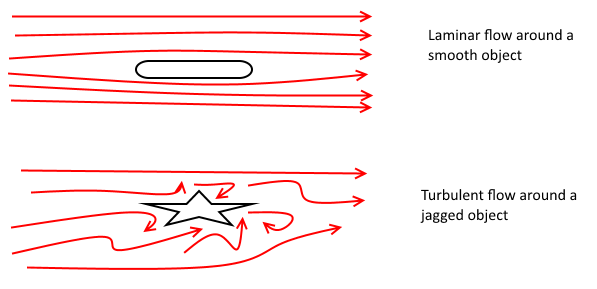
When laminar flow is established can be harnessed to generate the sail and foil forces with minimal drag.  When a flow becomes turbulent the amount of force we can generate drops significantly, and the amount of drag increases.  To put it another way, we’d like all the fluids moving around our boat to have laminar flow if possible.

How do you know you have laminar flow?  Look at the tell tales on your sail.  If they are streaming backwards, they’re getting caught in the laminar flow as the wind blows across your sail.   Great!  If your tell tales are spinning around, flapping forwards and then back, or other erratic behaviour, then they are getting caught in one of the eddies, which indicates you have turbulent flow.  Turbulent flow means your sail is not generating as much power, and there is more drag on your rig.

We can’t see tell tales on our foils, but we can look at the water behind the boat.  If the water in our wake is relatively smooth, then then foils are not generating much turbulence.  If our wake is full of bubbles, and little whirlpools, then its and indication that our hull is dragging significantly.  Reducing hull drag is beyond the scope of this write-up, but try sitting farther forward in the boat and using less rudder if possible.

Apparent Wind

True wind is what the wind is doing relative to the ground (or water, or other stationary point).  You may be in a lull, or a gust, or just steady wind.  Whatever the case, if the wind is blowing 10 knots from the North relative to the surface, then that is the true wind at this point in time.

Induced wind or boat wind is the wind that’s created by moving across the surface.  If the true wind is dead still, but you’re riding a bicycle at 30 km/h then you “feel” a wind on your face as if it’s blowing 30km/h right at you.  That’s induced wind — wind created by your motion over the ground.

Apparent wind is the combination of the two.  Let’s say the wind was blowing at 10 km/h and you were riding a bike at 30 km/h directly into the wind.  You would “feel” 40 km/h (10 km/h true wind, plus 30 km/h induced wind).  If you were biking away from the wind, you would feel 20 km/h.  If you were biking sideways to the wind, you’d “feel” the wind come at you at about 32km/h from and angle about 32 degrees.

When you are travelling slow, the induced wind is small, and apparent wind is pretty close to true wind.  When you are travelling very fast the apparent wind becomes closer to the induced wind.

You’re sails operate on what they feel — the apparent wind.  So if you’re at a standstill on a beam reach, your sails “feel” the true wind coming from directly beside you.  As your speed increases, you’ll be generating more induced wind.  This will make the wind “appear” to come from more in front of you.  As you speed up, the boat may move from a beam reach to a close reach, even to close hauled just be speeding up.

Another example is gybing a Laser in strong wind.  You want to be going as fast as possible when you gybe.  If the wind is blowing at 20 knots, and you’re going 5 knots in the direction of the wind, then there’s 15 knots of apparent wind coming behind you.  Tough as hell to gybe that.  But, if you’re going 15 knots downwind, then there’s only 5 knots of apparent wind coming behind you.  That’s a walk in the park!  So catch a wave, get up on a plane, do whatever you need to do to speed up that boat heading into that gybe!

Side note – Some boats can sail faster than the true wind on reaches.  That’s because it’s not the 5 knots of true wind that is operating on the sail, it’s the 20 knots of apparent wind that the sail is using.  The 29er, for example, will sail at a speed of about 18 knots on a broad reach in 12 knots of wind, and you’re actually “tacking” through the apparent wind when you gybe.


How Scoring Works – Appendix A Demystified

The Racing Rules of Sailing (RRS) contains a suggested mechanism for scoring at regattas, detailed in Appendix A of the rules.  A regatta doesn’t have to use this mechanism (the Sailing Instructions, or SIs, for the regatta will describe the scoring system) but Appendix A is a popular choice.  This article describes how Appendix A works, and talks about the changes to Appendix A that KSC uses for our weekly race series.

The Basics

In simple terms, you get one point for being first, two points for being second, etc (Rule A4.1).  At the end of the regatta, the boat with the fewest points wins (like golf) (Rule A2.1).

Sounds simple, right?

The devil is, of course, in the details.  What happens if a boat doesn’t race?  What if a person crews for one boat one race, and a different boat the next?  How do “dropped races” work, that kind of thing.

Breaking the Rules

Generally speaking, a boat that breaks a rule (or doesn’t race) is scored as if it finished “last place plus one”.  If there are 10 boats in the regatta, you’d normally expect the scores to be 1 point (for the first place boat) to 10 points (for the last place boat).  If only 8 of the 10 boats participated in the race, they would score 1 to 8 points, and the two boats who did not race are scored 11 points each.

Boats might not race for a number of reasons — maybe the didn’t show up for the race, they were unable start the race in time, they were over the start line early (and didn’t rectify the issue), they had problems and had to leave the race, etc.  Under Appendix A, these situations are generally treated equally (by awarding “last place plus one”).

The other situation where a boat will be scored as “last place plus one” is if the boat is disqualified.  This typically occurs when a boat breaks a rule (maybe it caused a collision when the other boat had right-of-way).  A boat can exonerate itself by doing penalty turns (usually two 360 degree turns) as soon as it is able to safely do so.  If a boat doesn’t do its turns, it may be disqualified and awarded “last place plus one”.

There are other conditions which could cause a change to a score.  The judge could decide to award someone a score based on where they would have likely finished if a boat were interfered with, or a boat may be penalized a certain number of points for some types of infractions.  Generally speaking these cases are quite rare, but you should know that they do exist.

Some common “scores” which you’ll see on a scoring sheet:

Code Meaning
DNC Did not come to the starting area (didn’t show up for the race)
OCS On course side (you crossed the start line early)
DNS Did not start the race in time (other than DNC or OCS)
RET Retired (you started the race, but headed back to port before finishing)
DNF Did not finish the race in time (but were still trying)
DSQ Disqualified (broke a rule and didn’t do your turns)
BFD Black flagged (started early when black flag was up)
UFD U-flagged (started early when U flag was up)


Dropped Scores

Everyone has a bad race now and then.  Furthermore, maybe there was a tough situation and you got disqualified for breaking a rule one race.  This might not make a big difference in a regatta with only a few boats, but in a big regatta with 50+ boats, then having one bad score can completely kill your chances of placing well.

Enter “dropped scores”.  This lets you ignore your worst scores from the regatta.  Appendix A allows you to ignore your worst score in the series (Rule A2.1), although it is more typical for the SIs to specify a number of scores to exclude based on the number of races sailed.  This might be worded something like “excluding her worst score when 5 – 11 races are scored, or her two worst scores when 12 or more races are scored”.

In regattas, one dropped score per five or six races is typical, whereas weekly race series often allow for more dropped scores.

Boats and people

One final thing to note about Appendix A (and the RRS in general) is that they talk about a boat as the entity participating.  In other words, the people on the boat don’t matter, it’s the boat that races.  Let’s say you have an Albacore with sail number 8034.  The Albacore’s place will be scored in each race regardless of who is skipper, who is crew, etc.  At the end of the regatta, it’s the score that “Albacore 8034” has which determines it’s position.  For most regattas, this is fine — the boat will typically be skippered and crewed by the same people for every race.

Kanata Sailing Club Races – Changes from Appendix A

KSC took the Appendix A rules, and makes a few adjustments to suit our needs.  The first big one is that we score people, and not boats.  At KSC race nights, where we have people constantly changing boats from one week to the next, scoring a boat doesn’t really work.  Our solution is to have every sailor pretend to be a boat (as far as scoring is concerned), and we score each sailor as if they finished in the place their boat did.

Let’s say that Alice, Bob, Charlie, and David are racing.  Bob is crewing for Charlie.  In the first race, Alice finishes first, Bob and Charlie second, and David third.  Alice gets one point, Bob and Charlie each get two points, and David gets three.  In the next race, David wins, followed by Alice, and finally Bob/Charlie.  David gets one point, Alice two, Bob/Charlie three.  The total score at the end of the second race is: Alice (3 points), David (4 points), Bob (5 points), Charlie (5 Points).  Scoring can continue from there the next week even if Bob and Charlie sail in different boats, or Alice/David sail together, etc.

The second change we make is that we allow for a lot of dropped scores.  We might be changing the ratio in the future, but as of 2016 we allowed for 1 dropped score for every 4 races scored.  This means that if you miss a week you’re not overly penalized.  But it also means that you do have to show up for a few weeks and score consistently well during those weeks to win the series.

Unlike a regatta, we don’t know how many people will show up over the course of the series.  On a good night we might have 10 boats racing (maybe 3-4 Lasers, 3-4 Albacores, a Byte, maybe a 29er or Hobie Cat, etc).  Basically, we figured that we probably won’t have 15 boats.  We chose the number 15 as a the score for people who don’t show up (“DNC” or “Did not come to starting area”) so people who don’t show up get an automatic “15th place”.

A final change we made is that we thought it would be better to reward those who made an effort to race above those who didn’t show up.  Boats who are disqualified, do not start in time, forced to retire, etc are awarded points better than the 15 points awarded to those who didn’t start. In the following table, the number of points “n” indicates the number of points for the last boat who finished the race normally.  Note that even if we do have an abnormally huge number of boats racing, your score will not be higher than 15.

Code Points Meaning
DNC 15 Did not come to starting area (no show)
OCF n+1 On course finish
DNF n+2 Did not finish race
RET n+2 Retired (started race, but left to go back to club)
DSQ n+3 Disqualified (ex. broke rule and did not do turns)
DNS n+3 Did not start (is on the water, but didn’t cross start line in time)

2016 KSC Open Regatta

D2C_2480

It’s that time of the year again, Labour Day is approaching and (with it) the KSC Open Regatta!  Come one, come all to our club and test your skill against some of the Ottawa area’s best racers.

Albacore and Laser sailors can expect a great 2-day event with lots of fun and great people.  We are pleased to announce that this year’s prizes are beautiful beer mugs with club and class logos etched in (mug for first place Laser, and a mug each for skipper and crew of first place Albacore).

As always, sailors of other classes of boats are welcome to participate in fine racing (however will be ineligible for prizes).

A change over previous years is that a light lunch will be provided on the water for all participants who register before Saturday August 27!  So sign up now!

Details:

Date: Sept 3-4, 2016 (Sat/Sun Labour-day weekend)

Entry fee: Single-handed $25, Double-handed $35 (discount for classes with no prizes)

Notice of Race

Sailing Instructions

Race night report, Aug 1 and Aug 8

Well, apparently I didn’t write a report for Aug 1, so this one will have to serve for both

Aug 1

A big wind day saw lots of close racing.  Emily, Heidi and Stephanie set up a short course with a 20 minute target time, and we managed to get 4 races in (wow!)  A significant shift to the right meant that the later races were not quite square to the wind, but it made for great racing.  The cat (Tony/Annie) scored its first win of the season in Race 2, and the 29er showed what it could do with the spinnaker in the gusts, but the Albacores were the consistent winners.  Dominic/Jeremy took the night with 1/2/1/1 finishes, with Ken/Frank S (2/4/2/2) following.  Jean/Frank (Albacore) and Max (Laser) tied with 3/5/5/3 and 5/3/4/4 finishes respectively.

Aug 8

The first of 3 races saw big wind and waves, while the second and third were light-air races.  The course was much more square than the previous week (great job, RC) and good close racing followed.  Carla/Steve (Tasar) took the night with 3 1st place finishes, followed by Ken E/Norm with 3 2nd place finishes.  Jason (Laser) scored 3/3/4 to round out 3rd place for the night.

Standings so far

The Summer Series 2 standing have Ken E (12 points) in the lead with Frank and Jean tied for second (23 points).  Carla (26 points), Jason (28 points) are challenging Frank and Jean with a group of racers (Tony, Dominic, Jeremy) all at 35 points.

The Season has Ken E in a healthy lead (36 points) with Jason (63 points) and Dominic (83 points) the closest contenders.

Full results, as always, available on the racing page at http://kanatasailingclub.com/sailing/racing/

Race night report, July 25, 2016

Series report after race report

Very light air and changing weather conditions challenged the sailors for the final night in Summer Series 1.

As the tail end of a thunderstorm was blowing through the area, the racers were debating whether or not to hit the water.  The clouds certainly looked like they had passed, and sunny skies were above, but most folks waited  a good half-hour without any thunder or lightning before rigging up.  This meant that we only got 2 short races (rather than the planned 3) in for the night, and several boats didn’t make the 1st race either.

The first race saw an extremely close contest between Lino/Dominic (Albacore) vs Ken/Corinne (Albacore).  As Ken/Corinne were coming up to the leeward mark on the last leg, Lino/Dominic made a sneaky play and overlapped the boat, forcing Ken/Corinne to give mark room.  The finish was very close with Lino/Dominic taking the race  and Jennie/Andrew (Albacore) coming in 3rd followed by a 4th place OCF for Chunshu (Laser).

The second race was a bit better attended with Jason/Norm (29er) joining the fray.  A tough start saw a few boats struggle to get on port tack in a light wind shift, with Jason/Norm and Lino/Dominic fighting for a puff of air at the pin end.  A few decent gusts came and we still had a fairly close race rounding the windward mark.  Jason/Norm put their spinnaker up, but the shift in the wind meant the gybe mark was almost dead downwind, and they couldn’t catch the Albacores.  The next leg was fairly processional, and a shifty final upwind to a shortened course windward mark meant Ken/Corinne took the race, followed by Jennie/Andrew, Lino/Dominic, Jason/Norm and Chunshu.

Summer Series 1 Results

What a great series it has been!  We had 3 good windy nights, and two lighter air nights with 11 races run in total (no cancelled races!) and awesome turnout.  We were fortunate enough to have guest sailors (including  Dominic, Andrew, and Jasper) and 30 sailors took part in at least one race.  It is my pleasure to announce those who have bragging rights for the next 5 weeks:

Old hands
3rd place: Jason (29 points) (yay)
2nd place: Ken E (23 points)
1st place: Dominic (18 points)

Rookies
3rd place: Kevin (88 points)
2nd place: Jean (81 points)
1st place: Norm (65 points)

Complete results, as always on the Racing page

Honourable mention: This race series ran so smoothly due to the efforts of our Principal Race Officer (PRO) Mario Poirier who also ran the Spring Series.  Mario was out in the RC boat every single Monday ensuring that the course was set up, that the results were recorded, and that everything was run smoothly.  Mario will be out of town for Summer Series 2, so we probably won’t see courses set quite so square to the wind for a while…

Complete Season Results

We’re 2/3 the way through the season, with 5 race nights left.  Because we only completed 4 races in the Spring Series, the season more closely resembles the Summer Series 1, but there’s still time to shift things around.  Ken E leads the scoring (28 points) and Jason is a distant second (41 points).  Corinne is positioned third (59 points), but Dominic is coming on strong (63 points).  There’s still lots of time for things to shift (perhaps up to 150 points depending on how many races we get in during the fall) so nothing is set in stone yet.

See you on the water!

Race night report, July 18, 2016

What a night with the wind blowing like crazy, and the sailors moving like crazy to match!  Steady winds in excess of 15 knots and gusts to the upper-20s were the order of the night, and some sailors elected to stay ashore rather than fight the wind and waves.  Mario found an RC volunteer (many thanks, Norm) to run the race, which allowed Heidi and Emily to take the second boat out as a rescue boat.  Turned out to be a good call, as a catamaran capsize and tow in was needed before the first prep signal went up!

In an effort to make these posts shorter, I’ll try to limit myself to one or two paragraphs per race…  First race saw a boat-end favoured line, and a good clean start.  Steve/Carla (Tasar) pulled away from Dominic/Monica (Albacore), Luc (Laser) and Jason (Laser) early on.  Slightly late starts by Frank/Jean (Albacore) and Mike R (Byte) followed.  A sloppy tack to port by Jason meant that Dominic/Monica could tack and get above him.  Luc elected to stay on starboard, however the wind slightly calmed on the that side of the course, meaning he lost boat speed.  Not much change is position from there (great defending by Dominic/Monica to fend off Jason on the reaching legs).  Final results were Steve/Carla (Tasar, 1st, by a mile), Dominic/Monica (Albacore, 2nd), Jason (Laser, 3rd), Luc (Laser, 4th), Frank/Jean (Albacore 5th), Mike R (Byte, 6th) with an OCF 7th for Mike T/Jasper (29er).

The 2nd race saw Jennie/Andrew (Andrew’s 1st time sailing!) join the fleet in an Albacore, and the 29er was in the thick of it from the beginning.  A slightly favoured pin end of the line led to congestion on the start.  Steve/Carla, Dominic/Monica, Mike R , Luc and Jennie/Andrew all had good starts.  Frank/Jean came up from behind with the 29er bearing on.  Jason messed up the start (got tangled in the mainsheet) and was forced into a poor port tack start behind most of the others.  He was able to find a hole in front of Frank/Jean and the 29er to sneak through, but was well behind the rest of the fleet.  But surprise!  A capsize (and quick recovery) of the Dominic/Monica Albacore meant that we had tight race on our hands.  At the leeward mark (well, for most boats — Steve/Carla were already well on their upwind leg by the time the others reached leeward mark) something amazing happened…

The 29er was first to hit the mark and head upwind.  They weren’t making good headway, so they tried to foot on port tack… farther, and farther and farther.  The Albacores followed.  Luc and Jason recognized that a major shift to the right occurred, jumped immediately on starboard tack and pointed straight at the mark.  By the time the other realized their mistake, the Lasers were in 2nd and 3rd (and everyone waved to Steve and Carla crossing the finish line).  Jason was able to maintain 2nd place for the final downwind leg and finished without issue, but the real battle was between Luc and Jennie/Andrew’s quickly approaching Albacore.  The shift meant that the Albacore’s superior pointing ability didn’t come into play, and it was down to raw speed between the two on a close reach.  In the end, the Albacore took it by half a second (both boats had to check with RC to see who finished first between them).  Dominic/Monica (Albacore), Frank/Jean (Albacore), Mike T/Jasper (29er) and Mike R (Byte) rounded out the finishes.

We now quite a pack in the summer series standings — Dominic (1st place, 14 pts), Ken S (17 pts), Jason (19 pts) and Ken E (20 pts) are right in the thick of it, with one race night to go.  Also, note that we’re at 9 races currently, and one more drop comes into effect at 12.  If we somehow manage to get 3 races in next week then this will come into play.

Summer series 1 and complete season standings can be found on the racing page

Post race, Mike R (sailing the Byte) stayed on the water to help a Laser that was struggling to get back to shore in the strong winds.  The power boat whipped out with Luc, Jennie, Andrew and Jason aboard to assist, and Luc volunteered to to jump into the Laser to help the boat back.  A huge shout out to Mike R, Luc, Jennie and Andrew for keeping an eye on safety, and having fun in a safe environment is what KSC is all about!  Many thanks again to Mario for running a fantastic race, Norm for riding RC, Emily and Heidi for running mark-set/rescue boat!

12-Mile-Island Regatta Results

Battle at the Leward MarkWell, the wind didn’t cooperate for 12-Mile-Island, and the very light air meant that we were forced to sail with a shortened course (many thanks to instructor Heidi for dropping a mark out by Pinhey’s Point to act as the “Island” for the day).  The 11:00 start (monohulls) saw several boats out for more of a “float” than a sail, and it didn’t look like they had much of a head start by the time the Hobie 18 (12:00 start) was approaching.

The wind did pick up a bit (especially on the Quebec side of the river) as the day went on, and perhaps the course was shortened a little too much.  The target time for the regatta is 4 hours for monohulls, and 3 hours for catamarans, but the first monohull completed the course after about 2.5 hours (Frank and Jean crossed the finish line at 1:26:07pm after an 11:00am start).  Still, I’d rather have a fun 2.5 hour race than a boring 5 hour one…

Actually, the shortened course translated into a close race — all boats (including the cat) finished within a window of 22 minutes, and the adjusted times were even closer.  Although Richard in the Laser finished about 10 minutes behind Norm and Monica in an Albacore, the adjusted times were less than 2 minutes apart.  Similarly, the Tony and Ken E in the cat (1h 37m 42s elapsed time) were very close to Frank and Jean (2h 26m 07s ET).

The adjusted times (AT) are calculated by taking the elapsed time (ET) and multiplying by a handicapping factor called the Portsmouth Number (PN).  The formula used is

AT = ET * (1000/PN)

Okay, now the moment you’ve been waiting for…  remember, it’s the adjusted time that determines your placement…

 Ranking  Class/Sail  Skip  Crew  ET  PN  AT
 5  Laser 196258  Richard  –  2h 47m 20s  1095  2h 32m 48s
 4  Albacore 8034  Norm  Monica  2h 37m 58s  1045  2h 31m 10s
 3  Albacore 8033  Robert B  Tom N  2h 34m 17s  1045  2h 27m 38s
 2  Albacore 7485  Frank  Jean  2h 26m 07s  1045  2h 19m 49s
 1  Hobie 18  Tony  Ken E  1h 37m 42s  765  2h 12m 56s

Congratulations to 2016 12-Mile-Island Regatta winners, Tony Hendrikx and Ken Eaves!

A special thank you goes out to Heidi who dropped the rounding mark early in the day,  Annie and Emily for assisting on shore (and on the water) to make the day run smoothly, Robert for having the foresight to bring a few packages of bottled water for the sailors sitting in the sun, and Darren and Annie for pressure washing the upstairs deck on their duty day!

Race night report, Monday July 11, 2016

The third race night of Summer Series 1 was another well attended event, with at 8 boats racing (and a couple of more out on the water).  The wind was light, favouring those with good tactical abilities.

The first race was postponed a few minutes due the need for the RC boat to assist a boat on the water (thanks Mario & Ken!) but the delayed start did not help those boats who left shore quite late and did not make the start.  Mario’s trick of rigging the anchor with a fender float meant he could quickly unhook the anchor, perform the rescue, and pick up where he left off.  Of the racers who did start, Ken S took the race in a Laser, followed by Dominic/Norm in an Albacore (with nice bright and stiff sails) and Kevin/Sammy (Albacore).  Several boats (including Steve/Corrine in the Tasar who actually would have scored 1st…) crossed the start line after the start time elapsed and were not counted as part of the race.

The second race was quite well attended with 8 (14 people) boats on the start line.  A shift to the left meant that port tack would be favoured, and a lopsided line was identified by several of the veterans.  Steve/Corinne (Tasar), Ken S (Laser), Jason/Jasper (29er) and Dominic/Norm (Albacore) all were fighting for the pin end, and got great port-tack starts.  Kevin/Sammy, Valerie/Monica (Albacore), Jennie (Byte) and Tony/Annie (Hobie 16) rounded out the start line, and we had a race!

The first “beat” saw some people (like Jason/Jasper) try to point right at the mark, while others (like Steve/Corinne) went to the left side of the course where the wind was stronger.  99.9% of the time Steve is right, but it didn’t quite pay off this time, and the 29er rounded the top mark first.  The first reaching leg was closer to the wind than most had expected, and several boats (Steve/Corinne, Kevin/Sammy) made up distance over those who had their sails out too far.  The second reach was almost dead downwind, and saw a tactical blunder by Jason/Jasper, as they elected to head up to get some boat speed.  A lull was moving in and those on a dead run made up time on those who tried to reach, with Steve/Corinne rounding the mark first, Jason/Jasper 2nd and Dominic/Norm right behind them.

A shortened course meant the final upwind leg would determine the winner.  Steve/Corrine and Dominic/Norm elected to tack immediately and head to the left of the course where it still appeared windy.  Jason/Jasper stayed pointing to the mark and attempted to reproduce their success off the start line.  Steve/Corinne took first place, and the 29er and Albacore battled it out for second.  A beautiful tack right in front of Jason/Jasper gave Dominic/Norm a push and they were able to take 2nd place, with the 29er stuck in turbulent air, and Jennie in her Byte roaring in from the left.  Jason/Jasper managed to get the boat moving again, and secured 3rd, just in front of Jennie (Byte).  Ken S (Laser) took 4th over Kevin/Sammy (Albacore), Valerie/Monica (Albacore) and Annie/Tony (Hobie 16) were left with an OCF 8th place.

The dead wind meant a paddle in for several boats, but the food and drinks (thanks Tony!) felt well earned.  Many thanks to Ken E for performing RC (and rescue) duties with Mario!

As always, race results for the entire series (and season!) can be found at http://kanatasailingclub.com/sailing/racing/

12-Mile-Island Regatta, 2016 Registration

twelvemileislandphotoRegistration for the 12-Mile-Island Regatta is now closed

The event will be held on Saturday July 16, 2016.  Please see the Notice of Race (NoR) and Sailing Instructions (SIs, to be posted soon…) for event details, including how boat allocation will occur.

To register, enter the details of you and your team-mates below.  If you’re a lone skipper looking for crew (or crew looking for a skipper, or someone willing to do either) then send an e-mail to [email protected] and I’ll do my best to get you in touch with other sailors to form a team.

If you’re planning on sailing a club boat, we’ll work out who gets which hull the day of (i.e. of 4 teams all want Albacore 8033 then we’ll sort that out later… please see NoR/SIs for details).

The e-mail field is optional (not everyone likes to be spammed but the e-mail helps keep you informed of any changes, like if we have too many sign ups for a particular boat class, etc)

Race Night Report, July 4th, 2016

Holy smokes, what an awesome night!  A huge turn out (at one point we had 12 boats on the water, between the racers and those going out for a leisure sail) and great racing.

At 5:30 it seemed that the race might be cancelled due to low wind.  How wrong I was!  Albacores, Lasers, Bytes, a Laser 2, and a Hobie 16 were rigged up and hit the water as the wind started to build.  Decent starts by Dominic/Heather (Albacore), Ken S/Rob (Laser 2) and Jason (Laser) meant there was some congestion at the pin end of the start line and a bit of jockeying for position.  Before too long the rest of the fleet had crossed.  Jason was (surprisingly) able to keep up with Dominic/Heather for the upwind and on the reaching legs, but went to the right of the course instead of the favoured left on the second upwind.  Ken S/Rob and Ken E battled it out with Fanny/Vitali (Albacore) coming on strong.  Dominic/Heather took the race, followed by Jason, and Ken E had won the battle for third.

Race 2 was run after a shift to the left, favouring port tack.  Dominic/Heather correctly identified the shift and won the pin end of the line, while Jason, Ken S/Rob and Ken E had great starts as well, followed by Corinne (Byte), David R (Laser), and Tony/Annie (Hobie 16).  the wind continued to build and sustained gusts from the left of the course meant planing conditions.  Dominic and Heather dominated the race, and the real battle was for second.  On the upwind, Jason (Laser) got caught in dirty air behind Ken E (Laser) and Ken S/Rob (Laser 2) and lost a bit of distance as he had to reach out to the right side of the course into clean air.  The 1st reaching leg saw the Hobie and Byte catch up meaning the second reach featured a pack of boats all overlapped.  Ken E’s Laser was first to the leeward mark, followed by Annie/Tony (the catamaran), and Jason was able to sneak his Laser on the inside of the pinwheel (overlapped with Corinne, and Ken S/Rob).  The 2nd upwind leg began just as the wind picked up speed.  It appeared that Ken S/Rob got stuck in some turbulent air and lost some time as they entered the upwind.  The Lasers were able to put some distance between themselves and Corinne’s Byte.  Jason was able to use his, ahem, greater righting force (i.e. could stand to lose a few pounds…) to keep a flatter boat than Ken E without feathering, and passed him just before the upwind mark.  By this time Dominic/Heather were almost done their downwind leg and it was obvious that there would be no catching them.  The downwind was fairly processional for the rest of the fleet although the Laser 2 was able to make up distance on Ken E.  On the final upwind, some people were able to make the line just by staying on port tack (due to the shift) and Jason took 2nd place.  The real battle between Ken S/Rob and Ken E was tight, with the Laser 2’s greater hull speed and better pointing making a move on the Laser.  Ken E was able to hold onto it and scored 3rd place by about half a second over the Ken S/Rob team.

Although a few sailors went back to the club assuming racing was over (watch for the signal flags!) a third race was run.  Since your humble sailor director was ashore at the time, I’m afraid I don’t have a blow-by-blow account of the race, but again Dominic/Heather took first.  Ken S/Rob were able to grab 2nd this time over Ken E, with Frank/Jean (in an Albacore) and Kevin/Valerie (Albacore) rounding out the finishers (Corinne started the race but retired).

After racing, harbourmaster Robert organized a work crew to move some of the damaged Albacores up the ramp to the work shed — many thanks to all those who helped out!  Food and beverages followed (although a squirrel had gotten into the club house and cause a reduction in the number of hamburger buns before being chased off by Emily).  It was great to see so many people having a good time.  Many thanks to Carla and Hannah for running RC with Mario!  As usual, Series and Season results can be found at http://kanatasailingclub.com/sailing/racing/